
On November 23, 2026, OpenAI and Cisco launched Shirudo—an open-source Linux runtime that loads cryptographically signed eBPF shields so operators can block exploit paths on running services while permanent patches roll out. Cisco's newsroom post describes the same launch as an industry-first effort to let defenders start protecting systems before a permanent patch lands, using eBPF programs inside the kernel without editing kernel source.
If you run coding agents on laptops but also let those agents drive CI images, docker-compose stacks, or Elasticsearch dev clusters, the practical shift is not a new IDE setting. It is how your platform team might close the patch lag window—and how you should review when an agent proposes a temporary shield instead of bumping a Dockerfile.
TL;DR
| Question | Answer |
|---|---|
| Am I affected today? | Only if you operate Linux servers or CI hosts that cannot reboot quickly and that agents or scanners flag as vulnerable. Developer laptops without Shirudo installed are unchanged. |
| Is there a fix? | Permanent fix is still the vendor patch (for example OpenJDK's November 2026 refresh for Java4Shell). Shirudo is a pre-release temporary runtime mitigation path. |
| Does data leave my machine? | Shirudo targets can export telemetry to configured OpenTelemetry collectors per the GitHub README; that is operator-chosen, not automatic cloud upload from OpenAI. |
| What did OpenAI demo? | Codex-generated shield on a running Elasticsearch JVM that rejected Java4Shell input without restart—a controlled test cited on OpenAI's announcement. |
| What should I do now? | Patch JVMs and images agents touch, read pre-release kernel/TPM requirements, and treat agent-authored shields like signed change requests, not silent hotfixes. |
| How is this different from Bay or Falcon-style agent gates? | Shirudo hardens Linux infrastructure runtime. Products like Bay's Enforcer hooks or CrowdStrike Falcon Guardian focus on vetting agent tool actions on endpoints—not kernel eBPF on a database tier. |
What OpenAI and Cisco announced
Both vendors published on November 23, 2026. OpenAI frames Shirudo (Japanese for “shield”) as answering a narrow operations problem: patch testing and deployment can take days or weeks, yet exploit and legitimate traffic may share the same kernel or library primitive. Blocking the primitive outright can take the service offline.
Shirudo's proposed workflow, as described on OpenAI's post:
- Observe suspicious behavior with eBPF instrumentation at chosen kernel or application attachment points.
- Draft a shield—a targeted guard that blocks the vulnerable code path while allowing normal requests that do not hit the flaw.
- Test the shield against exploit attempts and representative workloads before enforcement.
- Sign and load the shield on the running system without restarting the protected service (demo: Elasticsearch with a Java attach-style mitigation).
- Record evidence with TPM-backed attestation so operators can verify what loaded, even under hostile admin scenarios described in Cisco's materials.
Cisco emphasizes cryptographic signing so a host verifies a shield before it runs, including when an attacker may already hold administrator access—a different threat model from prompt injection on a coding CLI.
Greg Brockman's quoted line on OpenAI's page states the intent plainly: finding a bug today does not mean every system can be patched tomorrow, so shared open tooling should let one team's shield benefit others.
How Shirudo works (mechanism)
OpenAI lists four design pillars—live protection, agent-speed defense drafting, trusted deployment, and hardware-backed verification. The shirudo-dev/shirudo README adds implementation detail that matters for anyone evaluating it next to agent workflows.
eBPF shields and upatches
Shirudo uses BPF upatches and Java agent upatches as small, logically contained programs. Operators on a control host build, sign, and push packages to an OCI registry; targets pull, the kernel verifies signatures against a sealed .bpf keyring, loaders run through the kernel's eBPF verifier, and TPM registers extend with each change so shirudo attest yields offline-verifiable evidence.
Boot-time enforcement on production targets starts when shirudo init attaches guards from the initrd—those guards are meant to protect Shirudo's own runtime from root on the target without the operator's signing key.
Guardian agent and observability
OpenAI's announcement includes a guardian-agent diagram for how eBPF instruments observe kernel and network activity while controls apply protections:
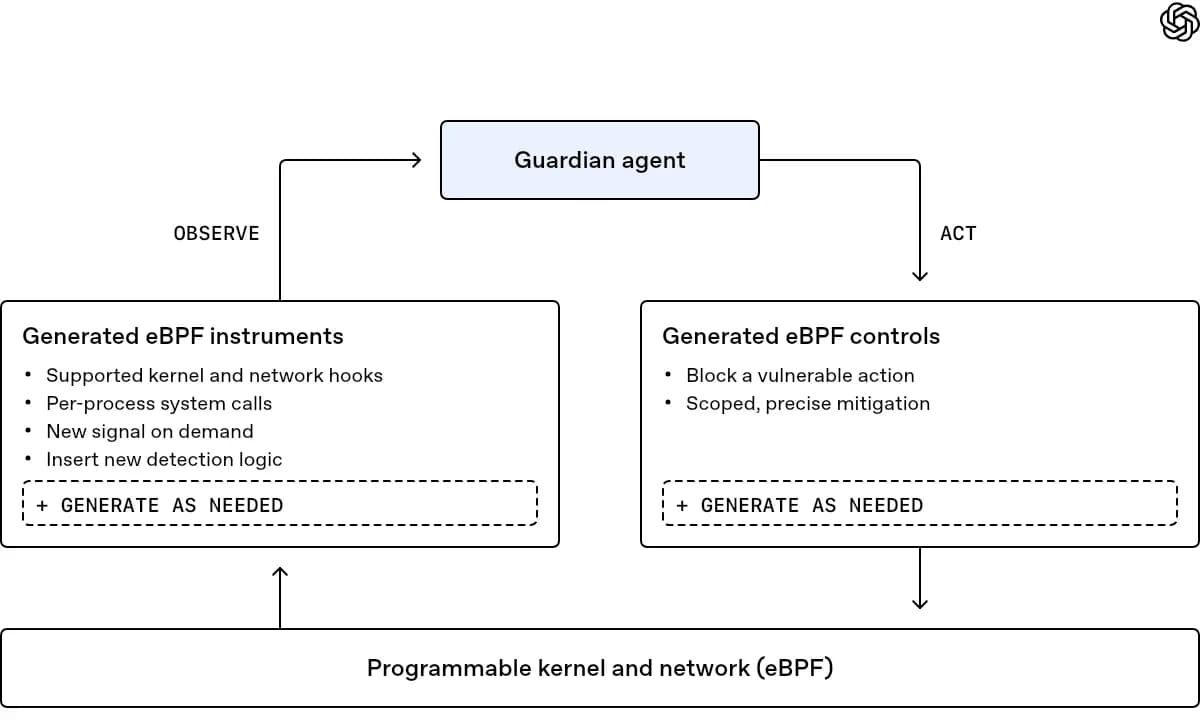 Image: OpenAI and Cisco
The README's kernel-obs package covers process execution, network activity, and privilege changes—overlapping what security teams want when AI-enabled attack planning accelerates lateral movement on Linux estates agents also deploy to.
Java4Shell connection (demo, not universal fix)
OpenAI cites Java4Shell against Elasticsearch as the public demo: Codex generated a guard on Java's Base64 decoder, attached to a live JVM, and blocked malicious input while the service stayed up. That directly intersects and our Java4Shell patch guide—but the November 17 disclosure already shipped OpenJDK builds; Shirudo addresses operators still stuck on vulnerable builds during rollout, not developers who can docker pull a fixed image today.
Cisco's release notes successful tests against Java4shell and a PHP flaw, positioning Shirudo inside an agentic control plane where Codex can draft mitigations when given vulnerability details—similar in spirit to OpenAI's large-scale Linux kernel exploit discovery pipeline, but aimed at runtime containment rather than patch filing alone.
Pre-release constraints you should not skip
The GitHub README is explicit: Shirudo is pre-release. Production targets need:
- A Linux kernel implementing Shirudo's signed-loader ABI and vendor kernel patches named in the docs.
- TPM 2.0 for measured upatch state.
- Architecture support as stated in the README (x86-64 and arm64 host tests; riscv64 validation pending).
CI publishes development packages from GitHub Actions artifacts; release tags land on GitHub Releases. That is evaluation infrastructure—not a one-line apt install on a generic Ubuntu agent runner unless your platform team has already qualified the kernel fork.
OpenAI points to a VM quickstart (software TPM), Isovalent's self-guided lab, and a December 15 webinar for hands-on work—reasonable next steps before you let a coding agent touch production loaders.
Step-by-step: from disclosure to signed shield (operator view)
This sequence synthesizes OpenAI's narrative and the README lifecycle diagram:
- Disclosure or scan identifies a reachable flaw on a fleet member (for example unpatched JVM on AVX-512 hardware per Java4Shell).
- Human or agent drafts an upatch that blocks only the exploitable branch (demo: Base64 decode guard), not all Base64 traffic.
- Regression tests run against exploit payloads and production-like workloads; Cisco says shields deploy only when evidence shows safety.
- Operator signs the upatch with org keys; target kernel refuses unsigned loaders.
- Pull-based deploy from OCI registry to the target; service keeps running.
- Attestation export to your evidence store (OpenTelemetry or offline verify) for change audits—useful alongside compliance-oriented agent action logs but not a substitute for them.
Contrast that with upload-to-RCE chains like Ghostscript CVE-2026-125396: permanent patch plus sandbox still wins; a shield is for the hours or days when neither has reached every pod.
What this means if you run AI coding agents
Coding agents change how fast steps 2–3 happen—not whether step 6 (vendor patch) can be skipped.
Concrete checks:
- Run
java -versioninside every container your agent edits in CI; Shirudo does not remove the need for the November 2026 OpenJDK refresh on affected hardware. - If an agent proposes a Shirudo upatch in a pull request, require the same review as a hotfix branch: signed artifact hash, test logs against exploit and benign traffic, and rollback plan.
- Separate laptop agent risk (credential leaks,
curl | bashskills) from server runtime risk; our agent security monitoring checklist covers the former; Shirudo is for the latter. - Watch for agents that disable mitigations to “unblock” builds—
-XX:-UseBASE64Intrinsicswas a documented Java4Shell stopgap; an autonomous agent might remove it for speed unless prompts forbid that.
When agents run on shared LiteLLM or guardrail gateways, remember unrelated RCEs such as CVE-2026-40217 on LiteLLM still need package upgrades; kernel shields do not protect a vulnerable Python proxy in front of your models.
How Beam handles this
Beam is not a Shirudo operator and does not load eBPF upatches. It is local-first observability and hook-based deny for coding agents on your machine: record tool calls, heuristically scan skills and MCP configs, and—when workspace policy is cached—deny selected PreToolUse actions on Claude Code and Codex. See how Beam watches agent actions and on-device storage.
Where the overlap is real: if Codex drafts shield code or curl-installs Shirudo packages, Beam can surface the shell and file writes and flag risky patterns in skills before you run them—but it does not verify eBPF signatures or TPM attestations on remote servers. Use Shirudo (or your platform team's equivalent) for fleet runtime; use Beam for developer workstation evidence and MCP/skill hygiene while agents accelerate patch and shield authoring.
Limits stay important: Beam's scan is heuristic, not malware analysis; missing cached policy is fail-open on denies; it is not a kernel sandbox. Shirudo's README likewise states pre-release status—neither tool absolves you of vendor patches.
What developers are saying
The Hacker News thread on the announcement had no substantive comments as of this post's research pass—only the launch link with minimal discussion. We will add a short comment roundup if reproducibility reports or kernel-requirement debates show up there.
Try Shirudo safely (from official docs)
OpenAI's post lists entry points without substituting for the docs:
- VM quickstart to sign, load, and verify a test protection (software TPM in the lab image).
- Isovalent self-guided lab for hands-on eBPF exploration.
- December 15 webinar registration for a technical deep dive.
- GitHub: github.com/shirudo-dev/shirudo for code, issues, and contribution paths.
Treat each as lab-only until your security architects map kernel patch lines to your agent-built Kubernetes versions.
Related reading
- Java4Shell (CVE-2026-114938): OpenJDK RCE and agent-directed discovery
- Bay AI Agent Security: runtime hooks and enterprise enforcement
- Ghostscript Upload2Shell: why patch speed still matters for agent-built pipelines
- LiteLLM CVE-2026-40217: guardrail proxy RCE separate from kernel shields
- AI agent security monitoring on developer machines
- OpenAI's 948 Linux kernel CVE discovery pipeline
- OpenAI Alfozan Codex wiretap case — separate lesson when employees misuse Codex on insider paths (November 24, 2026)
Frequently asked questions
The FAQ in the page metadata answers the highest-traffic questions in full; this section mirrors them for on-page readers.
What is Shirudo from OpenAI and Cisco?
Shirudo is an open-source, eBPF-based Linux security platform announced November 23, 2026. Operators build and sign mitigations, load them on running systems, and collect TPM-backed evidence. It targets the patch-gap window, not permanent vendor fixes.
Is Shirudo production-ready?
Not yet. The README calls the project pre-release and lists kernel patches and TPM 2.0 for production targets. Start with the VM quickstart.
How did the Java4Shell demo work?
OpenAI describes Codex generating a Base64 guard attached to a running Elasticsearch JVM; exploit input was rejected without restart. Still patch OpenJDK per the advisory.
What is agent runtime security?
Infrastructure runtime security (eBPF/Java upatches on servers) versus coding-agent runtime security (tool-call gates on laptops). Shirudo is the former; local hooks and scans address the latter.
Where is the source?
github.com/shirudo-dev/shirudo, BSD-2-Clause with dual-licensed BPF programs.
Should agents deploy shields alone?
No. Cisco and OpenAI describe human approval, signing, and validation before enforcement. Keep change control on any agent output.
What should developers do today?
Patch JVMs and images agents modify, scope agent tasks so they do not skip rebuilds, and use workstation observability for the commands that install or sign shields.
Version numbers, kernel requirements, and repository layout are accurate as of November 23, 2026; Shirudo is pre-release and may change quickly—confirm on shirudo.dev and the GitHub README before production experiments.